SKLGP大讲堂第124期 | Kasun Hewage & Jianbing Li
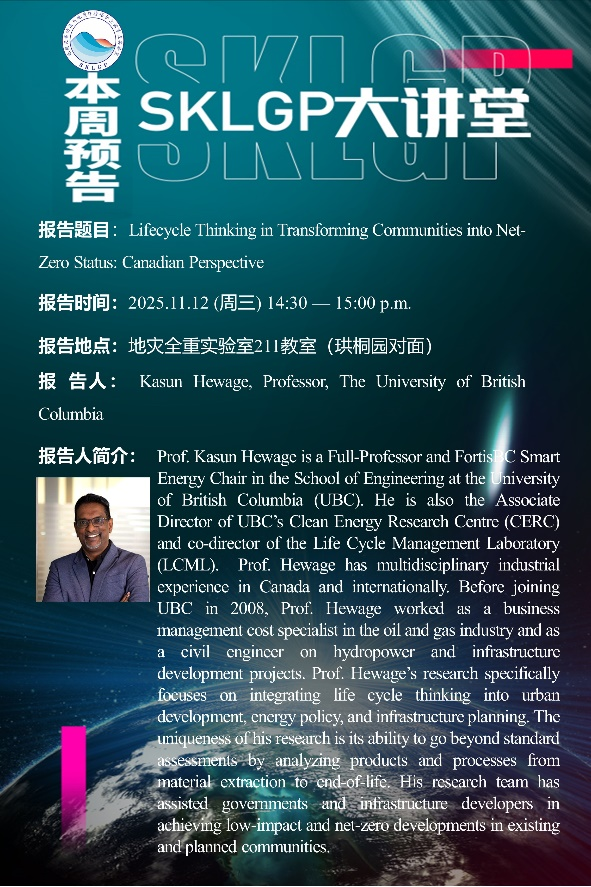
报告题目1:Lifecycle thinking in transforming communities into Net-Zero status: Canadian Perspective
报告人:Kasun Hewage
单位:The University of British Columbia
时间:2025年11月12日14:30—15:00(周三)
地点:地灾全重实验室211教室(珙桐对面)
报告人简介:
Prof. Kasun Hewage is a Full-Professor and FortisBC Smart Energy Chair in the School of Engineering at the University of British Columbia (UBC). He is also the Associate Director of UBC’s Clean Energy Research Centre (CERC) and co-director of the Life Cycle Management Laboratory (LCML). Prof. Hewage has multidisciplinary industrial experience in Canada and internationally. Before joining UBC in 2008, Professor Hewage worked as a business management cost specialist in the oil and gas industry and as a civil engineer on hydropower and infrastructure development projects. Prof. Hewage’s research specifically focuses on integrating life cycle thinking into urban development, energy policy, and infrastructure planning. The uniqueness of his research is its ability to go beyond standard assessments by analyzing products and processes from material extraction to end-of-life. His research team has assisted governments and infrastructure developers in achieving low-impact and net-zero developments in existing and planned communities.
报告内容简介:
The presentation by Prof. Kasun Hewage highlights a series of success stories that demonstrate how life cycle thinking translates into practical pathways for achieving net-zero outcomes. Featured projects include: A Path Towards Net-Zero Communities in Cold Climates, which models decarbonization strategies for regions facing extreme weather conditions; Micro Carbon Capturing and Utilization, which advances innovative small-scale carbon capture and reuse technologies; and Life Cycle Thinking-Based Energy Retrofits for Residential Buildings, which identifies cost-effective methods for reducing emissions in existing housing stocks. Additionally, the presentation highlights complementary studies on low-carbon energy transitions, including the integration of hydrogen and renewable natural gas, sustainable infrastructure planning, waste-to-energy systems, and community-scale carbon mitigation initiatives. These studies illustrate how holistic, life-cycle thinking–based approaches can drive meaningful progress toward resilient, net-zero communities. Together, these projects demonstrate how LCML’s research framework connects technology, policy, and community engagement to advance the transformation toward net-zero living. The insights offer valuable guidance for international collaboration, where shared challenges and opportunities for sustainable community development continue to emerge.
欢迎广大师生踊跃参加!
地质灾害防治与地质环境保护全国重点实验室
2025年11月10日
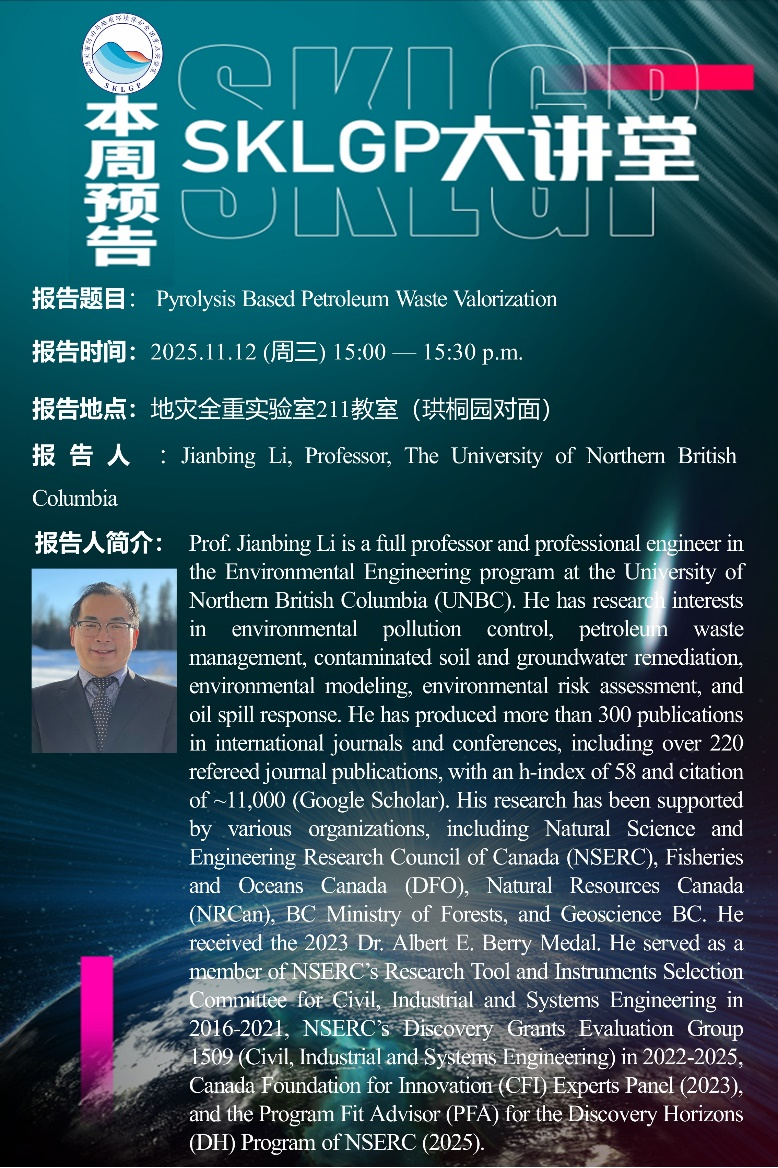
报告题目2:Pyrolysis based petroleum waste valorization
报告人:Jianbing Li
单位:The University of Northern British Columbia
时间:2025年11月12日15:00—15:30(周三)
地点:地灾全重实验室211教室(珙桐对面)
报告人简介:
Prof. Jianbing Li is a full professor and professional engineer in the Environmental Engineering program at the University of Northern British Columbia (UNBC). He has research interests in environmental pollution control, petroleum waste management, contaminated soil and groundwater remediation, environmental modeling, environmental risk assessment, and oil spill response. He has produced more than 300 publications in international journals and conferences, including over 220 refereed journal publications, with an h-index of 58 and citation of ~11,000 (Google Scholar). His research has been supported by various organizations, including Natural Science and Engineering Research Council of Canada (NSERC), Fisheries and Oceans Canada (DFO), Natural Resources Canada (NRCan), BC Ministry of Forests, and Geoscience BC. He received the 2023 Dr. Albert E. Berry Medal. He served as a member of NSERC’s Research Tool and Instruments Selection Committee for Civil, Industrial and Systems Engineering in 2016-2021, NSERC’s Discovery Grants Evaluation Group 1509 (Civil, Industrial and Systems Engineering) in 2022-2025, Canada Foundation for Innovation (CFI) Experts Panel (2023), and the Program Fit Advisor (PFA) for the Discovery Horizons (DH) Program of NSERC (2025).
报告内容简介:
Petroleum sludge is a typical solid waste generated in the oil and gas industry. It contains a variety of hazardous substances such as polycyclic aromatic hydrocarbons (PAHs) and toxic metals, and the improper handling of sludge may cause adverse environmental effects. Meanwhile, petroleum sludge represents a recyclable resource due to its high oil and carbon contents. Given such dual characteristics, pyrolysis presents a viable approach for transforming this hazardous waste into valuable products. However, many technical challenges and limitations still exist in petroleum sludge valorization. In this presentation, the main methods used for petroleum sludge valorization will be reviewed, with an emphasis on waste pyrolysis. A machine learning based modeling approach is introduced to predict and optimize the sludge pyrolysis process, and a co-pyrolysis method with wood waste is examined through a series of laboratory experiments to investigate its oil recovery and heavy metal immobilization efficiency. Experimental studies are also introduced to examine the utilization of pyrolysis char as an effective adsorbent for heavy metal remediation and oil/water separation. The results indicate that the sludge pyrolysis holds great potential to be used for waste valorization practices.
欢迎广大师生踊跃参加!
地质灾害防治与地质环境保护全国重点实验室
2025年11月10日