报告题目:A High-Performance Integrated hydrodynamic Modelling System (HiPIMS) for catchment/city-scale multi-hazard, multi-process modelling
报告人:梁秋华
单位:英国拉夫堡大学
时间:2023年7月13日上午10:00-11:30(周四)
地点:新实验楼211教室(珙桐园对面)
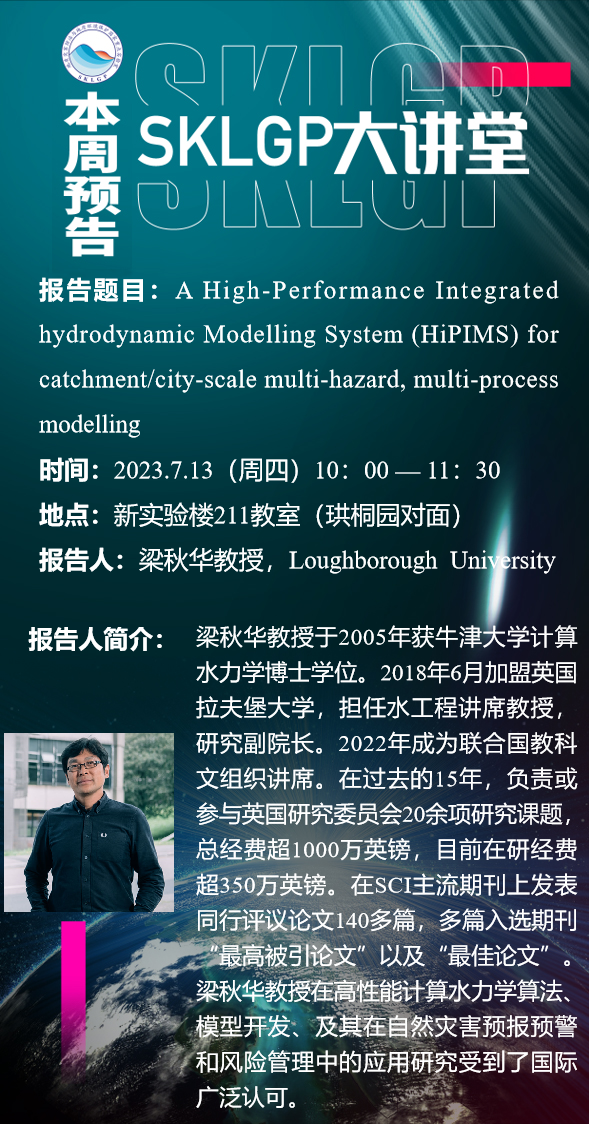
报告人简介:
Prof Qiuhua Liang (梁秋华)received his BEng in Civil Engineering from Dalian University of Technology, China in 1997, and DPhil in Computational Hydraulics from University of Oxford in 2005. He started to work as a lecturer in Newcastle University in March 2006, and had since been promoted to senior lecturer (2011) and full Professor of Hydrosystems Modelling (2013). He joined Loughborough University as Chair Professor of Water Engineering in June 2018. He was the Associate Dean for Research of his School and holds the UNESCO Chair in Informatics and Multi-hazard Risk Reduction. Over the last 15 years, he has worked as PI or Co-I on over 20 major research grant contracts from the UK Research Councils and other funders, attracted over £9M of research budget to the host universities. He has published more than 140 refereed papers in leading ISI journals and several of these papers were ranked as the ‘highest-cited papers’ by the respective journals (e.g. Advances in Water Resources and Computers & Fluids) and received ‘best paper’ awards. He has been invited as visiting/adjunct professor in Kyoto and Kobe Universities in Japan and several universities/research organisations in China. He is also associate/editor of several academic journals including Journal of Hydrology, Journal of Hydro-environment Research, Geoenvironmental Disasters, ICI-Water Management.
报告内容简介:
Disaster risk reduction (DRR) is one of the global challenges central to achieving the UN’s sustainable development goals (SDGs). It is widely recognised that the risk and impact of flooding and other climatic hazards are on the increase. This is expected to create more devastating impacts on people and their properties and impose growing pressure on critical infrastructure systems. Much current DRR research and practice is “siloed”, with modest consideration of the systemic nature – inter-connectedness and inter-dependencies – of complex risk landscapes with multiple interacting drivers that impact multiple human actors, infrastructures and built environments. We urgently need innovative and effective tools and solutions to better understand the systemic risks from multi-hazards and adapt our infrastructures and wider society to become more resilient to the increasing disaster risk and climate change.
This talk will introduce our continuous research effort in developing a high-performance hydrodynamic system (i.e. High-Performance Integrated hydrodynamic Modelling Systems, or HiPIMS for short) to predict surface water flooding and other hazardous processes from intense rainfall across an entire catchment/city at unprecedented resolution. HiPIMS solves the fully 2D shallow water equations using a shock-capturing Godunov-type finite volume method. Innovative numerical methods have been developed and implemented to handle wetting and drying of very shallow overland flow over complex terrains. The model is further implemented on multiple graphics processes units (GPUs) to achieve high-performance computing, enabling high-resolution and stable simulation or forecasting of high-transient flood dynamics as well as other relevant processes across an entire city or catchment of 100s or even 1000s of km2. New modelling components have been further developed to consider the interactive human and social dynamics during a hazardous event, potentially allowing systemic risk assessment and management by taking into account dynamic vulnerability and adaptation capacity.
欢迎广大师生踊跃参加!
地质灾害防治与地质环境保护国家重点实验室
2023年7月11日